








ARLINGTON, Texas—Renowned journalist Bob Schieffer’s career has seen him cover many of America’s most important moments dating back to the 1960s.
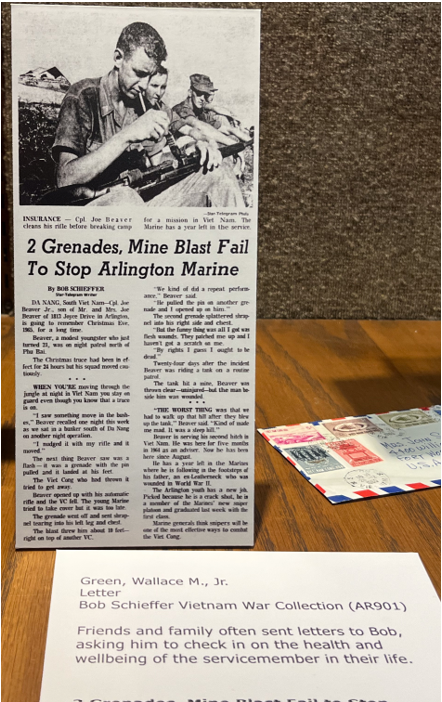
But even with the many inaugurations, political conventions and the three presidential debates he moderated, Schieffer said he believed his career never mattered more than the times he connected families split apart during the Vietnam War.
In 1965, during his time at the Fort Worth Star-Telegram, Schieffer convinced his editor, Jack Butler, to send him as a correspondent during the Vietnam War. The plan was simple: The Star-Telegram would depend on wire services and experts when it came to talking with generals, and Schieffer would track down the sons of Tarrant County families and relay messages from their loved ones back home. As advertisements rolled out letting people know what Schieffer was doing in Vietnam, letters began to flow to the Star-Telegram.
“I never had the reaction to any story that I did in my whole career like the ones I would have from those young men,” Schieffer said. “I’d walk up to him and say, ‘Hey, I’m Bob Schieffer from the Star-Telegram, and your mother asked me to find out how you’re doing.’”
What followed were streams of tears from young men who were alone in a completely unfamiliar place. The visits reassured them they weren’t forgotten and helped them feel more at ease seeing someone from their hometown. Schieffer reached out to many soldiers serving in Vietnam, delivering messages to soldiers and reporting back to the Star-Telegram.
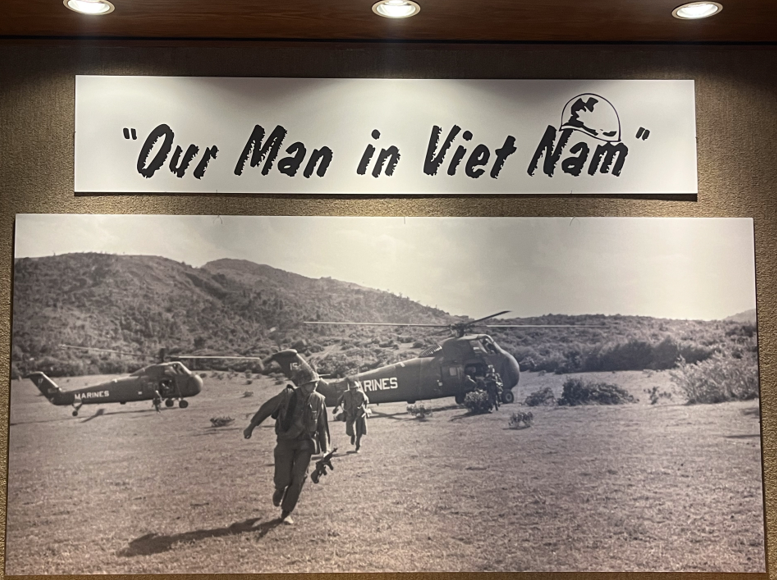
During his time overseas, he took many photos of his daily experiences. Many of the original negatives in the Star-Telegram’s collection—later donated to University of Texas at Arlington Libraries Special Collections—were scratched. Only a few digital photos were included in the collection, which held a deeper story Schieffer hoped to tell during his time in Vietnam.
That opportunity came with the help of university archivist Sara Pezzoni at the UTA Central Library. After meeting with Schieffer, Pezzoni received a donation of materials for UTA Libraries Special Collections—including photographs, letters and notebooks—all from his time in Vietnam, to be preserved and made available for generations to come.
With the Vietnam-related materials, Schieffer suggested creating an exhibit to showcase the photographs he donated. Working on a tight turnaround, Pezzoni began planning “Our Man in Viet Nam,” an exhibition focused not only on the photos Schieffer took during the Vietnam War, but also on four portraits he painted in 2025 based on photos of Texas soldiers serving in the war.
Schieffer also proposed tracking down the families of the veterans in the photos and reconnecting with them. That effort ultimately led to Schieffer painting their portraits to accompany the exhibit.
“The ultimate goal for him was to donate these paintings to the families,” Pezzoni said. “Those are going to go directly to those families once the exhibit is over.”
The families all expressed excitement about the idea and agreed to help in any way they could.
One of the men portrayed was U.S. Marine Corps Cpl. Joe Beaver Jr. of Arlington. The Texas resident attended a private showing of the exhibit and recalled a memory prompted by the image of him during the war. A rolled-up string placed underneath a rubber band around his helmet was used as part of a booby trap.
“I’d be out in the jungles, and I’d tape the hand grenade to a tree, and I’d pull the pin out, and I’d put a paper clip in there,” said Beaver Jr. “I’d pull the paper clip out and stick it through where the pin was for the hand grenade, and then I would tie the string to the paper clip, and I would tie it to a tree across from where I was, and if somebody tried to sneak up, it would blow up and wake me up.”
That sense of remembrance was shared by many veterans who visited the exhibit. They described their experiences as visitors stopped and listened to their stories after recognizing something familiar. It was exactly what Schieffer said he hoped to accomplish—to tell the stories of those who served in Vietnam.
“The story is about who you’re covering, and that’s what I wanted to make the point of in these stories about Vietnam,” Schieffer said. “It was about those kids. It was not about how I got the picture or how I found them. I wanted people to understand what they were going through.”
With Arlington hosting both this exhibit and the National Medal of Honor Museum, efforts to preserve veterans’ memories for future generations have pleased many in the community.
“I’m quite impressed to see a town that does that kind of stuff that cares a lot about it and preserves our memories for future people,” said Maj. Mike Golas, an attendee at the exhibit.
As the community gathered for the exhibit, which highlights an important chapter of American history, Arlington’s roughly 15,600 veterans—including more than 4,500 Vietnam veterans—could see the war captured through Schieffer’s lens.
“I would congratulate him because I think most of us veterans realize that there was a lot of misrepresentation about what happened during the war,” Golas said. “But he shows what really happened, and I really appreciate that.”
The exhibit is scheduled to run through April 4, allowing those unfamiliar with the Vietnam War to learn about the conflict and its many perspectives. Though a painful chapter in American history, Pezzoni emphasized the importance of educating visitors and highlighting the media’s struggle to portray the war—and how Schieffer worked to present a balanced view.
“The media at the time, I think, was struggling to portray the Vietnam War as it was, and all its many different sides, because I think there were so many different sides, and it was just hard to keep up,” Pezzoni said. “And a lot of people were upset with how it was portrayed by the media. And I think Bob was trying to balance that with, ‘No, this is actually what’s going on,’ and kind of show the good and the bad and make it more even.”
After walking through the exhibit, Schieffer expressed gratitude and praise for how Pezzoni displayed his work.
“I really feel honored to be a part of this,” Schieffer said. “Sara did such a wonderful job, and I couldn’t think of anything that I would change at all.”