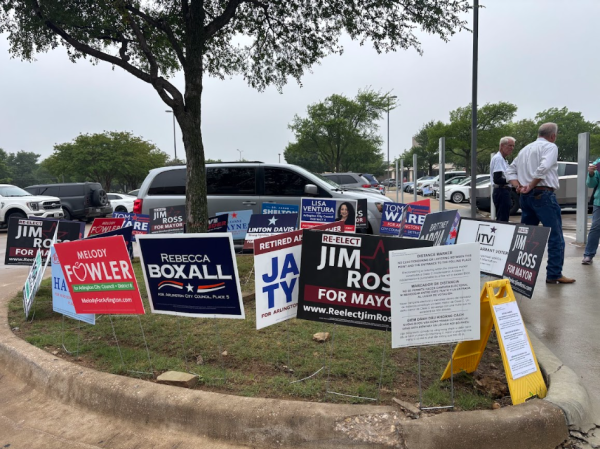












ARLINGTON, Texas—Toward the end of Arlington’s downtown at 700 E. Abram St., there sits the Tarrant County Sub-Courthouse, one of the six sites used for early voting for the May 2 election.
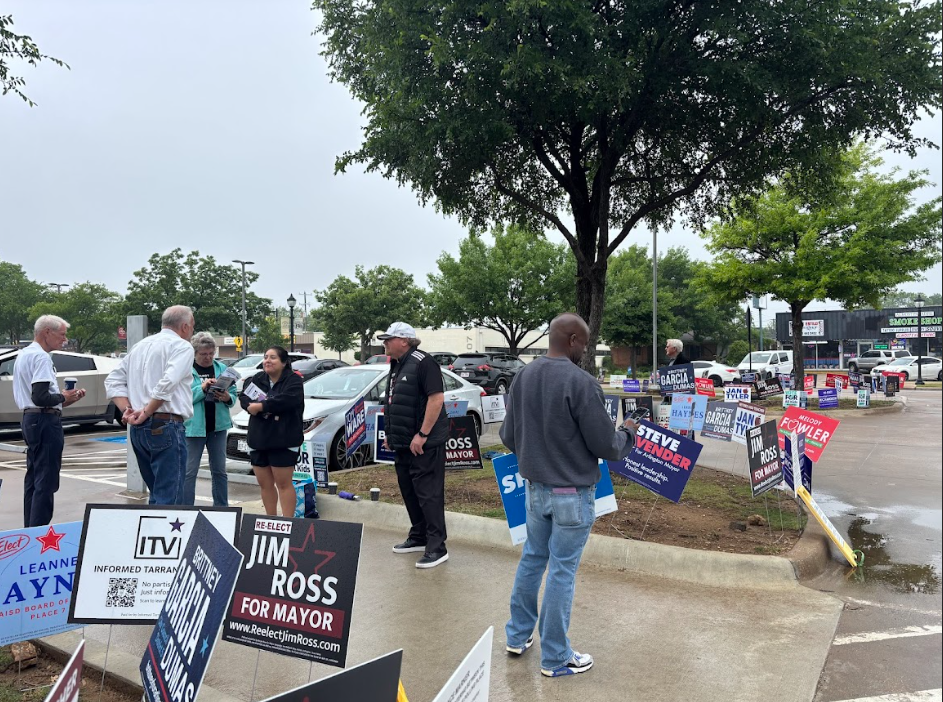
When early voting—which ended April 28—was in full swing, the lawn outside the courthouse was littered with campaign signs, and the walkway was filled with supporters and candidates asking for votes.
During this election, the people of Arlington will be voting on the mayor, City Council representatives for Districts 3, 4 and 5, Council At-Large for District 8, school district trustees and propositions affecting taxes in the area.
Dr. Jason Shelton, a University of Texas at Arlington professor and candidate for the District 8 citywide seat, said local government has a more immediate impact than many voters realize.
“Local government is more influential on our everyday lives than state government and federal government,” Shelton said in an interview. “This is where you pay taxes, where you interact with police, where you register your car. If you want to make an impact in your community, you’ve got to vote locally.”
Shelton, who has lived in Arlington for 18 years after growing up in Los Angeles and studying in cities including Miami and Cleveland, said the city must begin thinking of itself differently. Once perceived as a suburb, Arlington is now among the 50 largest cities in the United States—a shift he believes requires new approaches to urban challenges.
Among those challenges are housing affordability, transportation access and homelessness.
“We’ve got housing issues. We’ve got to have a more diverse range of options,” Shelton said, noting that younger residents may not be looking for traditional suburban homes. “You want to do other things with your lives. You need a wider range of housing options available.”
Community organizers are also working to engage younger voters, many of whom are voting in local elections for the first time, if at all.
Carol Raburn, president of Progressive Women of Arlington and a retired mechanical engineer, has spent months registering high school students across the city. She said she has visited all five Arlington high schools, registering hundreds of new voters.
“It’s our schools. It’s our city. It is where we live,” Raburn said. “Our mayor and our city council affect all of us, and we want Arlington to go forward.”
Raburn, who worked for companies including Peterbilt Motors, Boeing and Texas Instruments before retiring, said her transition into political organizing came from finally having the time to act on long-held concerns.
“I live here, and I care,” she said. “I’ve always cared about schools, but I’ve never really had time to help. So now I have time.”
Her efforts focus especially on younger residents, whom she believes are often overlooked in policy discussions.
“We feel like they’re not being heard,” Raburn said. “So we want to give them a voice. Helping them register to vote is the first step.”
Arlington Mayor Jim Ross, who has served in the role for five years and is seeking what would be his final three-year term, echoed the importance of local elections, calling them essential to the functioning of the city.
“It’s what controls everything in our own backyard,” Ross said. “School boards, city council, mayor’s race—that is what has direct impact on our lives.”
Ross pointed to the school bond election as a particularly critical item on the ballot, saying it will determine whether the district has the resources needed to support students.
Beyond education, Ross said Arlington faces the same pressures affecting cities nationwide, particularly a shortage of housing across all price ranges.
“Housing is the most difficult thing that is plaguing cities nowadays,” he said. “There’s a shortage of affordable housing, a shortage of luxury housing and everything in between.”
That shortage, he added, contributes to rising homelessness, another issue local leaders must address.
Despite these challenges, Ross described Arlington as a welcoming and diverse city, emphasizing its inclusive identity.
“We don’t care who you love or who you worship. You’re welcome here,” he said, describing the city in one word as “authentic.”
Still, turnout in local elections historically lags behind state and national contests, especially among voters under 30. Advocates say that trend can lead to decisions that do not fully reflect the needs of younger residents.
Shelton argues that increasing youth participation is key to shaping Arlington’s future.
“If you want to make change in your community, local elections are where it starts,” he said.
Raburn agrees, pointing to her work in high schools as a long-term investment in civic engagement.
“They care about affordability, transportation, food, all the things that affect their daily lives,” she said. “Now it’s about getting them to the polls.”
As Arlington continues to grow and evolve, candidates and organizers alike say the outcome of these elections will depend not just on policy debates but on whether more residents, especially younger ones, choose to take part in the democratic process close to home.