


















TOKYO—Rushing water complements the hue of green that blankets the ground, a low murmur echoing through the silence like a hymn to something older than time. The leaves shift in unfamiliar shapes, and flowers bloom in ways you have never seen, reinventing themselves with every step you take through Shinjuku Gyoen National Garden.

A simple walk, one that might seem uneventful elsewhere, becomes a passage into another world. It’s the kind of world carved by careful hands and ancient minds, one meant to please royalty—and once did.
This garden was the private estate of the Naitō family in the days of the Edo period. Later, it housed exotic specimens as a botanical garden. Then came the war. Bombs fell and fire raged, but the land endured. In 1949, it opened again, not for lords but for the people.
Now, 144 acres stretch out like a quiet rebellion against the steel and stone of the city. It is a place unbothered by the honking horns and hurried footsteps of Shinjuku. It’s a sanctuary where time, like the air, moves slower.
Chasing wind and laughter
Expanses of grass seem to beckon you to sit, to listen. Families lounge barefoot beneath the sun while their children chase wind and laughter across the open field. You feel it then, what the garden’s creators must have intended, a bond between soil and spirit.
Only the distant hum of a plane overhead reminds you of the world beyond the gate. Within the garden, time is not measured by clocks but by light shifting through branches and the soft crunch of gravel underfoot.
Turn any direction and you find a frame, statues half-sunken in shade, buildings set precisely where they belong, their geometry softened by vines and bloom. It is as if the entire place was composed, not planted.
The garden is divided into four sections, the Mother and Child Woods, the Japanese Traditional Garden, the Landscape Garden, and the Formal Garden. Each is a realm unto itself, carrying its own mood, its own voice.
The Japanese Traditional Garden winds around a still pond, its edge lined with pathways meant for quiet walking. Here, nature is not wild, it is deliberate. Everything points inward, toward thought, toward stillness. At the pond’s edge sits the Kyu Goryo Tei, a gift offered in 1927 to celebrate the marriage of Prince Hirohito. Its Chinese-style silhouette rises gently among the trees, dignified and half shrouded in mist. This place whispers of old ceremonies, of silk robes and silent footsteps. It is the image etched in the minds of those who dream of Japan, a garden that does not speak, but listens.
A regal calm
To the east, symmetry overtakes wildness. The Formal Garden spreads with a kind of regal calm. Its central rose bed, home to nearly a hundred varieties and hundreds more in bloom, is flanked by rows of London plane trees that guard the grounds like ancient sentinels. Come autumn, the air thickens with color, golden, amber, the burn of red, and the leaves fall like slow ash. The scale of it, the elegance, it humbles.
The Landscape Garden opens into vast lawns, where solitude is not emptiness but freedom. You could stretch out on your back and forget the sky once belonged to towers. A single tulip tree, tall as a legend, anchors the field. Its presence is quiet, immense. To the north, the Kyu Gokyu Sho rests, once a retreat for emperors, now an empty house holding echoes of long forgotten banquets and afternoons spent watching tennis from shaded porches.
And then, there are the Mother and Child Woods. A satoyama born of the need to let children in the city feel bark beneath their palms and dirt beneath their nails. The trees here are not manicured but wild, preserved. It is a place that reminds you the forest was here first. Wild birds trace paths overhead. Light sifts through the leaves in fractured beams. Here, you forget the city just beyond the gate. Here, the air is older, thicker. The kind that remembers things.

Like a diamond dropped into the earth, the greenhouse glows against the sun. Its glass panes shimmer with the shapes of leaves pressed gently against the surface. Step inside, and the world folds in.
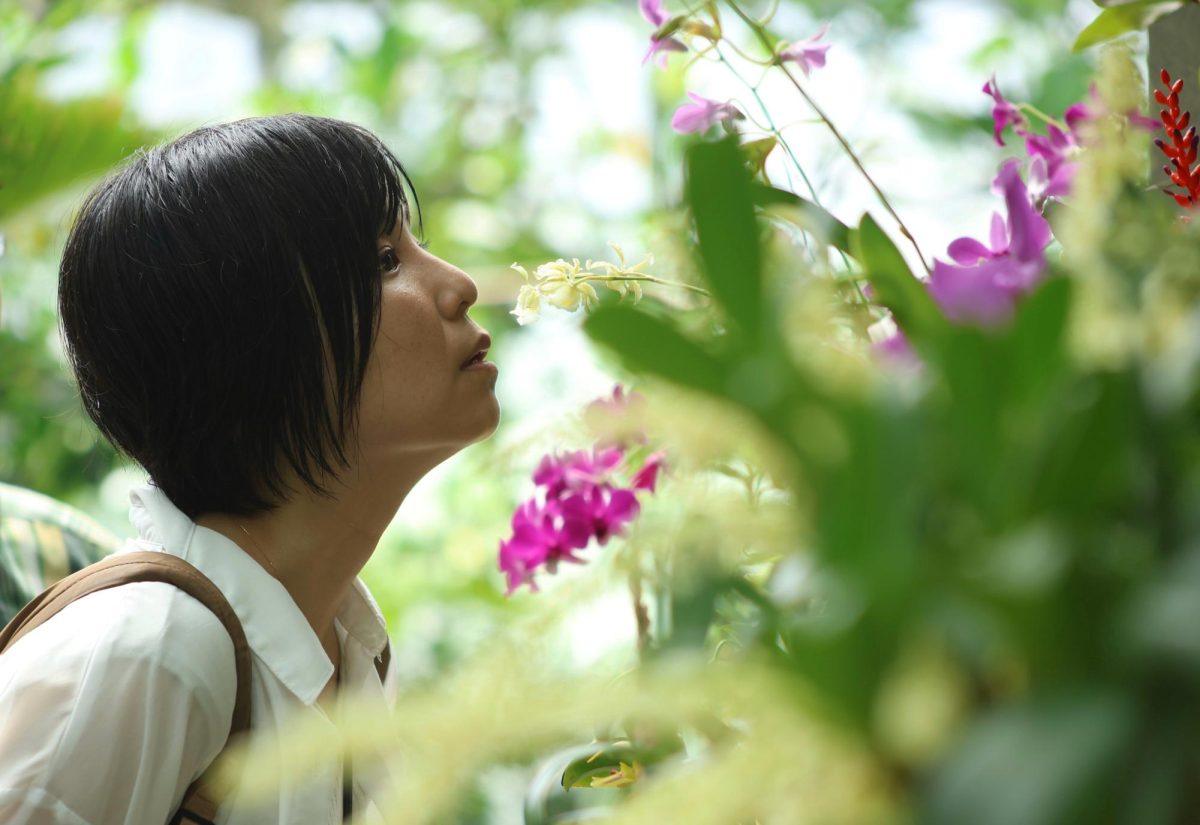
The air thickens. The light dims. Flowers unfamiliar in name and shape stretch from the walls and ceilings, reaching with slow confidence. Some leaves wider than your hand, others like miniature fans tucked away in crevices. Everything labeled, but the names do little justice to their strange and sudden beauty.
It feels like discovering new colors. Like finding an alien jungle mapped in shades of green and gold. You follow the narrow path, wondering if perhaps this is what explorers once felt. Awe without fear. Curiosity without end.
Every turn is a secret.
And when you finally step back out into the sunlight, with the garden fading behind you, there is a strange kind of quiet that clings to your skin. It’s as if a part of that world has followed you, tucked somewhere between your thoughts. You may leave Shinjuku Gyoen, but the memory of it lingers, like moss on stone, soft and patient, waiting for your return.