




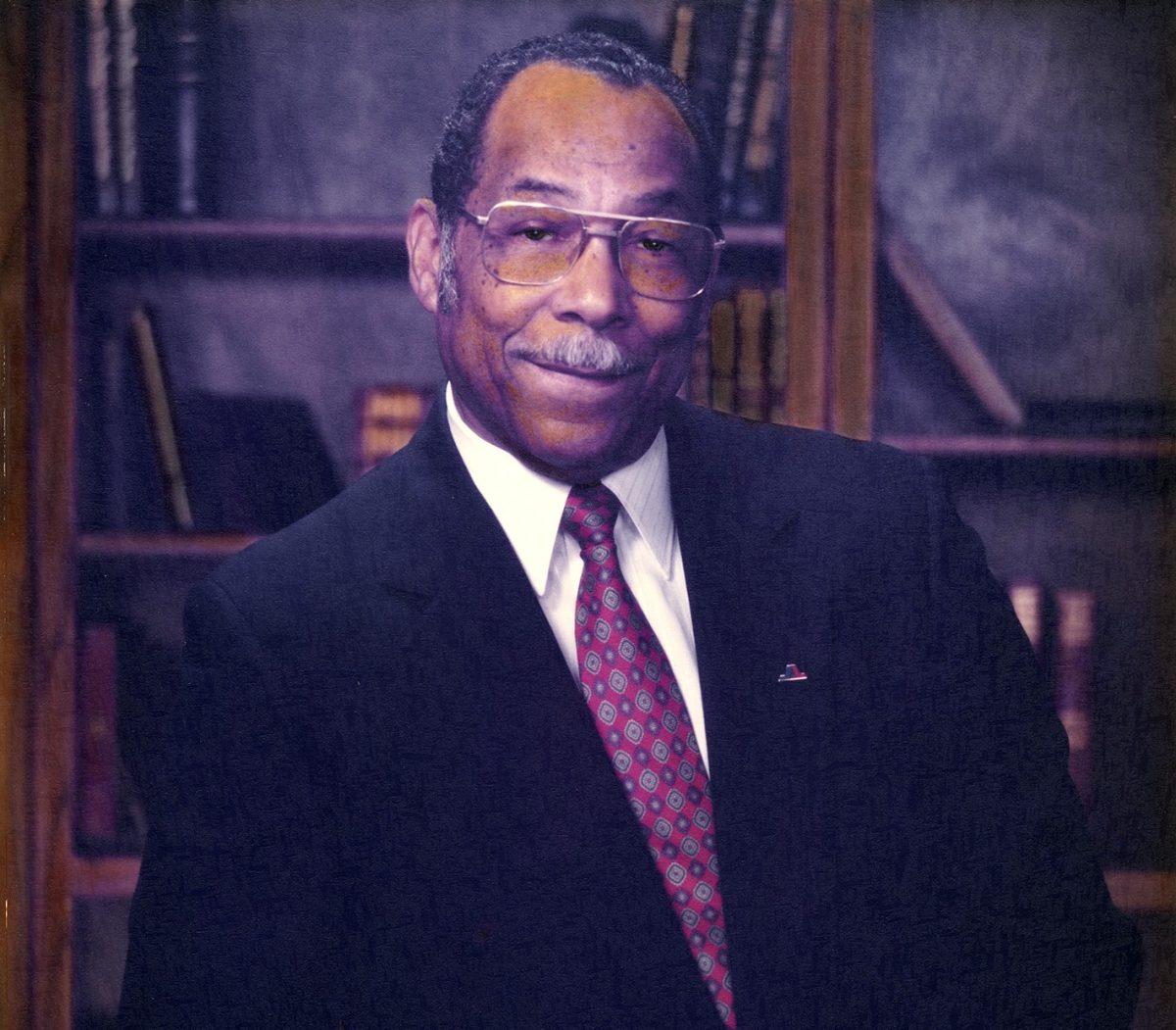




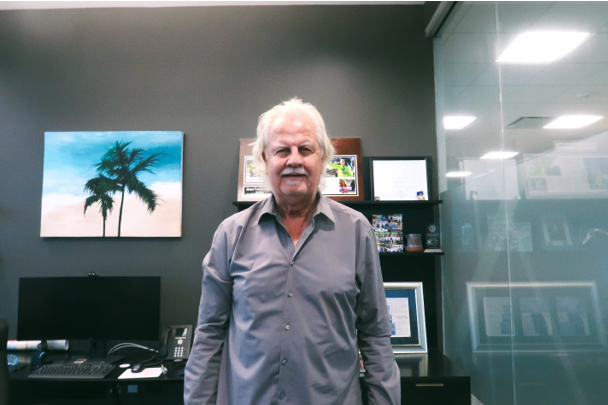
GRAND PRAIRIE, Texas—Mayor Ron Jensen is a longtime fixture of civic life in Grand Prairie, beginning in 2002 when he won election to represent District 6 on the City Council. First elected the city’s mayor in 2013, Jensen has also served as vice chair and chair of the North Central Texas Council of Governments Regional Transportation Council.
In a freewheeling interview, Jensen addressed the challenges of city growth, his concern for the safety of women and police, and entertained a wide-ranging conversation on journalism and how it’s changed. He also stressed the importance of community involvement and offered advice to students interested in civic participation. He also reflected on the political turmoil of the late 1960s and early 1970s and how those events shaped his early life and career choices.
This transcript has been condensed and edited for clarity.
Q: How have you seen local journalism change during your time as mayor compared with when you were a student at Grand Prairie High School?
A: That was the ’60s. We had a daily paper, and you would read the paper, watch 1News. I remember CNN was the first one that started doing around-the-clock news. It was because of some things going on back then. I couldn’t have told you what CNN stood for. For years and years and years, we did the 6 o’clock and 10 o’clock, then the first late night, Nightline, came on because of everything that was going on. They couldn’t fit in enough. Growing up, we watched the 6 o’clock news. If you didn’t catch it, then 10 o’clock, but as a kid, I was in bed. We were getting the newspapers. Now, when we get up, we turn on the TV and it’s right on the news. In 15 minutes, you can get a snippet of a lot. Then we liked watching the 5:30 World News Tonight with David Muir. He’s a journalist, in my opinion, but we get it all on our phones now. You pull up USA Today, CNN, all of them. So, we get our news in different ways, but now you have to be careful which one. I try to find one that’s neutral, not leaning one way or the other.
Q: Do you feel like the news is very scattered now, with everything that we have accessible on our phones?
A: Yes, but I have found some. You had to scan them all to get the top headline because some of them don’t carry that, and some of them do. Now, why should I care? About a bombing in a foreign country? Well, I do care. I traveled a lot. I used to travel. I’ve been to Singapore, Germany, Brazil; I’ve been everywhere. It does affect me because if you’ve been there, you say, ‘Oh my goodness. I was at that square.’ I remember when the double-decker red bus in London was attacked years and years ago. Cause we’d been there. Yeah, it is scattered. Some producer has to figure out what to show or not. That’s not easy. They get all these feeds. They probably have people watching other TV stations. Like, why did we not get that?
Q: I want to follow up on that because you mentioned international news. Do you feel that because we’ve gone so national, we’ve lost more in-depth about our community and more local news?
A: Yes. And I say it’s more national, but I tell my people when I speak. We can’t change Washington, D.C. We can’t change Austin. They’re gonna vote, but what we can do is focus on our community to help people in our community, not in a political sense. People need to feel a value, and I try to. Even though I watched the world news, I do not worry about who the mayor of New York is. I’ve found that usually things are overblown or underblown. They’re going to be fine. I’m still going to go to New York when I want to go. I don’t care. I’ve got friends of mine that are Muslim. They’re good people.
Q: When you think of transparency as a leader yourself, what does that look like? And how do you define it, and what steps do you personally take?
A: When I was first elected, it was like goodness, I hope nobody asks about this. The longer I’ve served, the more I realized, no, I want them to ask. If I can do the research and come up with why I’m going to vote for it, why can’t I tell you? And explain it to you so you can see my position. Now, I love getting questions. Do I change everybody’s mind? No, but I changed some. They just don’t trust us. I’m not going to say they don’t trust me. They don’t trust us. Government elected officials. I try to change that, I want you to trust me. Here’s why I voted for this. You could say, I didn’t think of it that way. I still don’t agree with you, but I never thought of it that way. Or, oh, now I see the backstory. There was more to it. I understand why. You see, I have gotten to where I don’t mind getting the questions, and I answer all of them. I get tagged every day. How do you reach me? You send me a message, and I respond. I’ve learned who to respond directly and who not to. I get messages like, ‘Mayor, you’ve got to take care of this, this person, this police officer, this code officer.’ I never respond with, ‘Oh my goodness, they shouldn’t have done that. I’ll take care of it immediately.’ No. I send it to my staff first, and they give me the backstory. Many times, the chief will call me. ‘Mayor, I’ve seen the body cam. That’s not what happened. They’re not telling you the whole story. Do you want to see the body cam?’ And I say, ‘No, Chief, you’ve never lied to me. Would you respond to them on my behalf?’ I always respond, sometimes not directly.
Q: What kind of news coverage or journalism do you wish Grand Prairie had more of?
A: Well, I wish we had at least a page in some, either the Dallas Morning News or the Fort Worth Star-Telegram. We do have the Rambler. It’s called The Rambler Printed Edition, and they do come to a lot of our events and interview me a lot. I would love them to expand their service to where more people in the Grand Prairie would get the Rambler, because it’s hard to make it as a printed magazine now. I wish we had some section, a page, half a page, in one of the major newspapers.
Q: Do you think it becomes harder for residents to stay informed as the city grows?
A: Yes! It’s a dilemma for us. How do we let those who live in our city know what’s going on? And that’s one of the reasons why we invested in those video boards all around the city, but even those, as you’re driving, you only see two things. You don’t see the seven, and then in our Pipeline [printed and e-newsletter] that goes to all water customers, that’s a good way, but not too many people open up the pipelines, read it. They’re so busy. Now, I get that. We raised three kids, and I’d get home. She’d take the girls; I’d take Eric to soccer practice. You don’t have time to sit down. I understand that. People are so busy, it’s just hard. You know, I get a lot of mine just by reading the top lines. We are trying to do a better job through social media, because it appears that’s the best way we can get the masses in Grand Prairie. Not everybody’s on Facebook, but most are. There are more people on our Facebook than reading our Pipeline. We try to post a lot of things.
Q: I watched your episode on Fair Play Politics, and you mentioned that something you’re most worried about in Grand Prairie is safety. So as the city continues to grow and change, what keeps you up at night when you think about the safety of Grand Prairie’s future? And how do you think the media can address those concerns?
A: Very good question. At night, I worry about our police officers — not necessarily the safety of our citizens, which doesn’t sound good, but it’s the truth. I’ve had my door knocked on at 1 a.m. for an officer we lost. A lot is going on overnight, especially domestic violence-wise, and I worry about our officers getting into a situation where, you know, a guy is drunk, he’s got a gun, he’s angry, and he doesn’t care. I worry about that a lot. I can’t do anything about that. I can’t make him go to marriage counseling. We can fund domestic violence programs and the charities that deal with that.
Of course, it goes without saying, we want to keep our roads safe and things like that. But I really do worry about women, because they’re the more vulnerable. I’ve just read too many reports from police all around that things happen. I pray that our police can handle the situation and calm it down without having to use force. In that particular episode, we were talking about expanding the city. I wanted to make sure we could keep enough police and fire staff to take care of that expansion. We work real hard at that so we can fund that. That’s a big goal for me and my council, especially since we just added some raw land that’s going to turn into homes within a year. That’s a big concern.
Q: I want to extend a little bit on what you mentioned in the Fair Play Politics episode. You talked about Mr. H. Wayne Hanks, and you spoke of him very highly — almost like he was a mentor.
A: He was almost a father. I had a loving father—my father was a Baptist minister—but Mr. Hanks was almost a father to me because I went to work for him when I was 21. Rebecca and I had just gotten married, and our son Eric was born two weeks later. So he helped raise me. Our company grew together. When I joined him, we were small—15 employees—and I traveled the world with him. He always taught me that insurance agents need to attend things and be out in public, so people know their names. Same with Realtors. My daughter and daughter-in-law are both Realtors, and they have to be out in the community and volunteer. Our business sells to the military, so the general public can’t walk in and buy anything from us. But Mr. Hanks felt that businesspeople in the community, even at my young age, in my 20s, needed to be involved. Not to help our business, but to help the community. He was my mentor for business and my mentor for giving back. He got me on the YMCA board. He never told me what to join, and he never told me to run for office, although I knew he wanted me to. But he wasn’t the type to push, because he knew it had to be Rebecca’s and my decision, a family decision. Yes, he meant a lot to me. He was a good friend of the former mayor I served under, Charlie England. And he wanted me to be mayor, but he also knew I wouldn’t run against Charlie. Mr. Hanks died in October before I became mayor in May, so he never got to see it. But his wife did. She passed a year after I became mayor, so at least she was able to see it. He had three daughters, younger than me, and I was always the son he never had. And my dad knew I loved him. It wasn’t a competition — my dad loved Mr. Hanks because of what he meant to me, and Mr. Hanks loved my dad. It was almost like having two fathers: one who raised me and was my spiritual father, and one who was my mentor in life and business.
Q: It says you studied psychology at the University of Texas at Arlington. Can you explain why you chose that?
A: The Vietnam War was going on. By the time I was in high school, in ’68 and ’69, public opinion had turned against the war. Veterans would come home, and you can talk to a Vietnam veteran now, and they’ll tell you things have changed in the last 20 years—but back then, they didn’t even want people to know they came back as veterans. What does that have to do with me? When I graduated high school, it was kind of like we wanted to all save the world. We were getting sociology degrees, psychiatry degrees, and liberal arts. We didn’t want to have a slide rule. We wanted to save the world because we felt like the world needed saving. There was so much turmoil. Dr. Martin Luther King was murdered, Kennedy was murdered, and Kent State, where the National Guard killed all those students. I thought about being a psychiatrist or a counselor. But during that time, the Army draft was going on. It was a lottery, numbers 1 through 365, based on your birthday. My number was 71. The top half got drafted. I was going to get drafted unless I stayed in college, because you got a college deferment. Would I have gone into the Army if drafted? Of course. I wasn’t dodging, but I wasn’t going to volunteer. I stayed in school. I started working for Mr. Hanks before I graduated from UT Arlington in ’73 and went to work for him in ’72. Rebecca and I got married in ’71, which means we’ll be celebrating our 54th anniversary. I decided that I needed to change my degree to business. I’m not going to get a job as a psychiatrist. Well, if you had changed your degree at that time, it would have added a year to my degree plan. I would have been drafted after four years without a degree, so I added business as my minor. My degree is a BA in psychology from UTA in 1973. So that’s why I have a psychology degree.
Q: What kind of advice would you give to college students who might want to pursue something more liberal and focused on helping their community?
A: Well, let’s say you’re that person. I would say: get involved in something now. If you want to give back to the community, go to a local charity and say, I think I want to do this. I think I may want to be a director when I grow up. Is there some way I can volunteer and help, just so I can get a touch of it? I challenge you to be an intern in the area you think you want to work. If you’re in college, try to find internships or summer work that’s connected to what you think you want to pursue. You may discover, wow, I really love this, or maybe, Oh. I don’t know if this is right. That’s OK, it’s not too late to change your mind.